

A Process To Harvest Green Electricity from Tidal Flow
Contents:
Executive Summary
About Hydrometric and the Hunter Greenhough Process
Impact Assessment and Proposed Solutions
Practicalities and Applications
Action Needed and Closing Remarks
Final Comments
Addendum—Comparing the Hunter Turbine with Wind Turbines
A process to enable Port Talbot and Scunthorpe to make green virgin steel cheaper than India or China and many other Intensive Users to get cheap green Hydrogen fuel.
Executive Summary
The proposal, dated 8th January 2025, is to generate green electricity, and from that green hydrogen and oxygen, using subsea
Hunter turbines.
These turbines are unusual in that they rotate in the same direction irrespective of the direction of tidal flow and are equally efficient regardless of the flow direction. Thus, there is no need to rotate them as the tide turns and as such, they are ideal for harvesting energy from deep water tidal flows.
The process generates completely green electricity and unlike wind or solar power generation, tides are always consistent. That said, generating electricity by tidal power has four main problems:
■ There are four slack water periods in 24 hours;
■ Electricity generated at night is worth less than electricity generated during the day;
■ The National Grid does not need all the extra night time electricity, and
■ Storing electricity.
All four can be overcome, however.
The extra electricity generated at night can be used to crack water into green hydrogen and oxygen that, unlike electricity, can be stored. It can then be used, for example, to drive a Parsons steam turbine programmed to generate electricity in the slack water periods at minimal cost to give a steady electrical supply to the National Grid. Alternatively, use a Hydrogen cell to change the Hydrogen to electricity.
Hydrometric, as a small company, is under no illusions that this proposal will require major investments from a consortium of
major companies and with government backing.
A hopeful sign is that the Labour government in its 2024 Autumn budget confirmed £2 billion of funding for green hydrogen projects and is committed to green power projects over the next five years.
Tidal power has obvious advantages over solar farms and wind turbines that depend on the sun shining and the wind blowing. Additionally, the moon does not issue invoices so the electricity harvested from tidal energy is at no cost once the capital costs of plant and maintenance have been covered.
It will give the UK a reliable source of power regardless of the weather and help fulfil the drive to a sustainable, zero CO2 economy.
In the following pages, this proposal will show exactly how that can be achieved.

Eur Ing Mick Greenhough
Managing Director, Hydrometric Ltd.
[email protected]
About Hydrometric and the Hunter Turbine
Hydrometric Ltd. was originally founded 30 years ago by Mick Greenhough, who is a European Ingénieur (Eur Ing—about the highest engineering honorific engineering ranking available in Europe and the UK). To become a Eur Ing you need to be a chartered engineer, a full member of an appropriate engineering institute and have a history of significant engineering achievements.
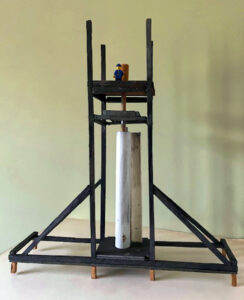
As such, Mick became a consultant engineer to the Hunter Turbine Project at Queen Mary’s University, London. This project was the brainchild of John Hunter and developed to the point where a working model was made and successfully tested in the River Thames.
The lead Professor then retired, and was not replaced, the project was completed then terminated by the university and the Hunter turbine patent (number GB2307722B) allowed to lapse.
Hydrometric has continued to further the project as the Hunter Greenhough Process (HGP).
The Hunter turbine consists of several opening blades that are hinged on a revolving drum. Flow visualization experiments on a small model were conducted by Queen Mary’s University to provide some basic rules from which the movement of every flapping blade at every drum position could be determined.
Two-dimensional quasi-steady CFD was then used to obtain detailed information about the flow field, including pressure and velocity contours, and the pressure distribution on the surface of the blades.
It was found that the Hunter turbine gives very satisfactory performance over a restricted range of flow coefficient. Under these conditions, the kinetic energy of the incident flow can be effectively transferred into the movement of the rotor, so that the average power coefficient (based on the projected area with an open blade) reaches a value of 0.19.
Using the CFD results, a polynomial function is fitted to the dependence of an effective force coefficient for all blades on the rotational angle and the flow coefficient. The net forces acting on the surfaces of the blades can thus be interpolated between the calculated data points.
Impact Assessment
The current method of transmitting electricity is by cables, mostly using monster pylons. Wayleave has to be paid to land owners and many people feel pylons despoil the countryside.
The current methods of transporting hydrogen are by liquefying or compression.
The power generated from moving fluids is a function of density and velocity3. PWatts/sec= ½ ɥAv3. Tidal water is 1,000kg/m3 and an average velocity of 2m/sec, Wind is 1kg/m3 and an average velocity of 7m/sec. Tidal flow thus has far more potential than wind.
Generating tidal electricity, from, say, the Pentland Firth or the Portland Race, would generate many gigawatts of electricity per 24 hours. The National Grid cannot currently cope as its cables are inadequate.
A possible solution would be to use the existing railway systems from Thurso and Portland Bill and build gantries of about 5-6 metres in height to carry power cables from the turbines. Where rail lines are already electrified this would means building new gantries or extending those that exist.
Rail track land is about 15 metres wide so those gantries could feasibly carry several heavy-duty electric transmission cables with a take-off at every station. Tunnels and bridges may need to be considered, but advantages include:
■ The countryside is not despoiled;
■ Rail track is owned by Network Rail so no wayleave costs need be incurred;
■ Given cheaper electricity via the use of rail track land, the National Grid could offer Network Rail discounts that could make rail travel cheaper;
■ It’s a system that could be used at other tidal races around the UK, most being close to rail lines.
Turning to other areas, the ability to produce copious amounts of green hydrogen via the Hunter Greenhough Process could impact other energy-intensive users. As an example, let’s look at steel production in the UK, a high energy user with the industry responsible for around 2% of UK greenhouse gas emissions.
Blast furnaces at the UK’s steelworks at Port Talbot in South Wales have been shut with the two at Scunthorpe marked for closure in the coming months. They will be replaced by ‘cleaner’ electric arc furnaces that use electricity instead of coke, but a concern is that they won’t be able to produce virgin steel or some high-quality steel varieties. Fortunately Scunthorpe has now been Nationalised but is still subject to very high energy costs.
The Hunter Greenhough Process (HGP) can resolve these problems in the following way:
■ In conjunction with Hydrometric, the Institution of Mechanical Engineers (IMechE) stages a seminar with the aim of forming a consortium of manufacturers to further the HGP;
■ To meet the UK government’s green power target, an estimated 3,200 new, and much larger, wind turbines will need to be installed by 2030. It’s worth noting that if the cost of 200 of those wind turbines is transferred to the Hydrometric consortium to construct 200 Hunter turbines, that should provide enough future funds to make the consortium eventually self-financing. The 200
Hunter turbines should generate 10 times the electricity of the 200 wind turbines. So…
■ Government to make a renewable energy grant to the consortium to produce an initial number of Hunter 25m deep x 10m diameter turbines to generate electricity from the six-knot tidal race off Portland Bill to prove the system;
■ The Port Talbot and Scunthorpe blast furnaces and all the associated machinery and equipment for making virgin steel bought by the government.
■ This new UK steel company uses government grants to purchase shares from the consortium in a number of
Hunter turbines as they become operative (number depending on their depth and tidal velocity);
■ The electricity generated by those turbines is then transmitted via the National Grid to the steel-making sites to generate hydrogen/oxygen for the furnaces via an electrolyser. As more turbines come on stream, more hydrogen and money from the shares is available until the generation of hydrogen equals the usage for virgin steel manufacture. This makes the fuel costs — and the pollutants — both effectively close to zero;
■ The ‘free’ income from those shares is ring fenced to pay for all the electricity used, thus making the steel very much cheaper to produce;
■ The Hydrometric consortium to use the income from the sale of shares to produce more turbines. They will also get reciprocal shares in the steel company to receive income from the sales of steel after production and sales of electricity to the National Grid;
■ The government will get its grants back many times over in the form of tax on the electricity generated by the turbines; VAT on the sale of steel and steel goods; income tax from the extra workers; and VAT from their purchasing of extra general goods and services over the following decades.
A similar approach would reduce the costs of other UK companies — eg: glassworks, potteries, cement manufacturers, and electric arc furnaces.
Practicalities and Applications
Among the many practical advantages of using the Hunter Greenhough Process (HGP) are the following:
■ Hunter turbines are 100 % recyclable at end of life;
■ A Hunter turbine costs about half that of a wind turbine, depending on numbers manufactured;
■ The Portland Race should be able to take 2,000+ turbines, the Pentland Firth about 10,000;
■ At Pentland Firth, bring the power to shore (identically as the Windmills) at a ‘farm’ to accommodate the inverters, storage, Parsons steam turbines etc, either to Dunnet Head or the uninhabited, 1.5 square mile Stroma Island in the middle of Pentland Firth for processing, then onto the Thurso rail head;
■ Large numbers of HGP turbines will give the National Grid leverage to pressurise wind mill owners to reduce their subsidies when the wind does not blow;
■ No government subsidies for the supplier, green levies for the consumer, nor backup power as the tide is continual 24/7;
■ No environmental problems to sea or land wildlife;
■ Turbines potential working life of 100+ years given appropriate maintenance;
■ All units of the HGP can be made in the UK;
■ Potentially, energy for the end user can be at low cost;
■ The turbines are not vulnerable to storms, heavy snow and severe hail, lack of wind or sun.
■ Government gets all its renewable energy grants and loans back as tax;
■ Less fossil fuel needs to be imported;
■ Will generate many extra jobs for UK workers and much work for UK manufacturing companies.
To turn to some of today’s existing problems, the National Grid cannot cope with night time excess electricity generated by wind turbines in strong winds and also has to turn to natural gas backup for extended periods of calm winds. Instead of paying for wind turbines not to generate electricity, engage HGP intensive users to take the excess electricity to generate hydrogen at a discount
or even pay them instead of paying the windmill owners not to generate electricity.
Given that delivery of electricity from Hunter turbines continually varies—from high at flood tide and ebb tide to zero at slack water—and the National Grid’s demands vary from peaks during the day to very little at night, a method is needed to smooth the flow of electricity to the National Grid. Green hydrogen can be used to do this.
A varying percentage of the electricity from the Hunter turbine can be siphoned off day and night to generate hydrogen to be stored for later use to drive the Parsons high pressure steam turbine mentioned earlier to compensate for times of low Hunter turbine generation. It should not be beyond modern computing techniques to develop the sophisticated programme necessary to control these continuing variations to give a steady, smooth supply of electricity.
Of course, there are disadvantages to the HGP:
■ Requires government upfront renewable energy grants to get established (returned in the form of tax many times over);
■ Initially, the first stage implementation of HGP, including forming the consortium, will take time. It will also take about two years to manufacture and install the first turbines, but once manufacturers are tooled up it should be a smooth, speedy process as has been seen with the installation of offshore windfarms;
■ Subsequently, HGP requires a steady investment flow from the consortium, though hopefully paid back by ongoing government renewable energy grants;
■ Every time the energy changes format — ie: using green electricity to make hydrogen and vice versa—there are losses that cannot be determined in advance, only in practice;
■ It will take a few years before the economic benefit is fully achieved;
■ Finally, planning permission may cause problems, though unlikely.
Turning to further practicalities, UK hydrogen/oxygen storage requires specially built containers. For hydrogen, austenitic stainless steel is typically selected for the many compression storage cylinders that operate in the range of 200 to 300 bar, such as when storing green hydrogen for later re-feed as energy to the grid. Manganese steel or chrome Molybdenum steel is usually specified for oxygen.
Applications
In terms of further applications, we’ve already mentioned putting heavy duty cables on gantries along railway lines. To take that a stage further, the benefits of electrifying the UK rail network, especially in terms of using HGP-generated electricity, are manifold:
■ Overhead electric trains cost 30% less to run than diesel-electric or third rail;
■ Electric trains are not only better for the environment, but are quieter and smoother for passengers while causing less wear and tear to the track;
■ They are more reliable and often faster;
■ Further electrification will help open up more diversionary routes, helping keep people on trains as planned rail improvement work is carried out;
■ Compared to diesel traction, electric services have lower rolling stock operating costs, higher levels of train reliability and availability and lower leasing costs;
■ Electrification can also play a role in reducing carbon emissions as well as improving air quality and reducing noise.
BEVS and HCEVS
Turning to the government’s current plan to try and persuade us all to move to battery electric cars (BEVs) or hydrogen fuel-cell cars (HCEVs), we have a chicken and egg problem: there are simply not enough electric charging points and an abysmal number of hydrogen refuelling stations. In fact, there are just seven as this is written and that’s a reduction from the 10 that existed in March 2022.
Many people think HCEVs rather than BEVs are the future. They can be topped up quickly, offer superior range capabilities than most BEVs; don’t have to compromise on space or practicality as a result of big batteries; and the only emission produced by fuel cells is water.
As long as hydrogen is created using 100% renewable sources, it’s completely sustainable, which is where the HGP consortium could come in. For example, by installing an electrolyser (operating at night with low cost electricity), gas storage cylinders and a compressor in a garage or at a fleet operators’ site—hopefully using a government ‘Reusable Energy’ grant—and charging the garage/site for hydrogen while retaining ownership of the equipment.
One other line of making hydrogen more available is to use portable, swappable hydrogen ‘cartridges’. These have already been developed for HCEVs by Toyota to allow HCEV drivers to swap out their power source when hydrogen levels run low rather than having to refuel at a garage.
That might also be a way forward for the HGP consortium.
Major UK Infrastructure
Looking to the hopefully near future and a major UK infrastructure application, Swansea Bay offers a huge opportunity with advantages above and beyond green electricity generation. It would entail the following:
■ Build a mole from Porthcawl to near Tenby to enclose a 200+ mile2 lagoon with an 8.5m tide that empties and fills twice daily;
■ Use the plentiful granite in Wales for the mole and old slag heaps for infill;
■ Build large sea locks for shipping;
■ Spaced every 100m or so in the mole, build sluice basins that can each contain several Hunter turbines;
■ Extend the M4 on to the mole and into Pembroke Dock to boost its potential.
Too extravagant? Have a look at Russia’s 24.5km-long St. Petersburg Flood Protection Barrier that comprises two navigation openings, six water sluices, 11 earth dams and forms a part of the ring road around the city.
To conclude this section, the tidal races around the Channel Islands run at over 5 knots during spring tides. Hunter turbines around
the islands could not only make the islands independent of electricity from France, but put them in a position to export electricity.
Upgrading Existing Electrical Infrastructure
The UK already has a huge number of wind turbines — 9,825 across 802 onshore and offshore wind farms in England, Wales, Scotland and Northern Ireland, according to 2024 figures. There are, however, problems:
■ Lifespan—about 20 years, perhaps 25-27, but as they get older their efficiency decreases;
■ Maintenance — turbine blades, generators and gearboxes often fail, so regular maintenance is vital. Varying degrees of expensive reconditioning and refurbishing are needed as they age;
■ End of Life Costs—by 2040, the UK faces the potential loss of nearly 9GW of onshore wind capacity as turbines reach the end of their operational life;
■ Theft—most large scale onshore wind farms are in remote locations making them easy targets (the same applies to solar farms). Copper theft is one of the biggest security issues as it’s high in value and relatively easy to strip from cables;
■ Dependency on Single Substations — multiple wind farms rely on a single substation to export power to the National Grid; efficient yes, but vulnerable in that it creates a single point of failure that can disrupt the entire power output. If alternatives were in place (see below) that risk could be mitigated;
■ Sustainability — while projects are underway to recycle turbines (eg: shredding fibreglass blades to use as raw building materials), it’s not currently cost-effective to recycle them.
The major problem, however, is severe/inconsistent weather—wind speeds higher than turbines’ operating limits result in shut down and if the wind isn’t blowing no electricity is generated either.
As it matures, the HGP consortium should install storage and other equipment at wind farm back up sites and use surplus wind turbines’ night time electricity to generate and store green hydrogen/oxygen. That can be used when there’s a lack of wind and the
generated electricity sold at daytime price to the National Grid. It mitigates the single substation risk and also obviates the need for imported gas and the cost of paying non-UK companies for not producing electricity. It would also improve wind turbines’ productivity by between 10%–50% (reasonable speculation) depending on the wind velocity.
■ Securing Hunter Turbines on the Sea Bed—the rig’s weight is enough to hold the turbine on the sea bed, though in some areas the strength of the current may be enough to move it. To prevent that happening, a 3m x 3m x 3m tank can be mounted on top of the rig. Filled with sea water, that would add another 27 tons.
A possible further application could be to use the tank to contain a number of lead-lined concrete caskets to safely store low-level nuclear waste. Casket 3m x 1m x 1m = 7.5 tons x 9 caskets = 60 tons
Action Needed
As said earlier, and as a small company, Hydrometric looks to a consortium of major players to turn the Hunter Greenhough Process (HGP) into reality.
Our first step is to work with the Institution of Mechanical Engineers (IMechE) in order to:
■ Organise a seminar for potential manufacturers and intensive users to present the HGP to them and establish a consortium of manufacturers to construct and install the Hunter turbines;
■ The consortium to lobby government for Renewable Energy funding. We also suggest that instead of building the planned 3,200 new wind turbines, the cost of 200 wind turbines is diverted to the consortium to build and install 200 Hunter turbines instead as a proving trial of their efficiency. The turbines should be self-financing from then on.
That calls for:
■ Consortium members to detail design and tool up and deliver the turbines;
■ Set up assembly facilities, probably initially in Portland Harbour;
■ Install several turbines in the Portland Race as the initial proving trial;
■ Discuss/negotiate installing gantries along railway lines from Portland Bill to Weymouth to supply electricity to the National Grid;
■ Monitor and assess results;
■ Assess the potential of Pentland Firth;
■ Plan for the future.
Final Comments
The Hunter Greenhough Process
is predictable, generates electricity 24 hours a day and can be controlled to match the varying demands of the Grid. It will last 100 years + and be 100% recyclable at the end of life. It is not at risk from severe weather or unpredictable wind or sun. It will go a long way to resolving the UK’s need for home grown and economic green energy, but it requires considerable up-front government funding. That funding will be repaid many times over in tax.
It will generate considerable and economically viable work for UK personnel and UK manufacturing companies.
It has the potential to considerably reduce the importation of expensive , non-green, foreign energy and no Idle Time subsidies are necessary.
Hunter turbines are completely benign, causing no threat to wildlife or the environment.
Yours sincerely
Eur Ing Mick Greenhough
Addendum
| HYDROMETRIC LTD—ADDENDUM
Comparing Hunter Turbines with Wind Turbines The Hunter Greenhough Process (HGP) will deliver green electricity that apart from being fed into the National Grid, can also produce almost limitless quantities of green hydrogen and oxygen. This table compares the efficacy of the Hunter turbine against wind turbines. The table takes into account that the power generated from moving fluids is a function of density and velocity3. PWatts/sec= ½ ɥAv3. Tidal water is 1,000kg/m3 and an average velocity of 2m/sec, Wind is 1kg/m3 and an average velocity of 7-8m/sec. Tidal flow thus has far more potential than wind. |
HYDROMETRIC LTD—ADDENDUM
Comparing Hunter Turbines with Wind Turbines The Hunter Greenhough Process (HGP) will deliver green electricity that apart from being fed into the National Grid, can also produce almost limitless quantities of green hydrogen and oxygen. This table compares the efficacy of the Hunter turbine against wind turbines. The table takes into account that the power generated from moving fluids is a function of density and velocity3. PWatts/sec= ½ ɥAv3. Tidal water is 1,000kg/m3 and an average velocity of 2m/sec, Wind is 1kg/m3 and an average velocity of 7-8m/sec. Tidal flow thus has far more potential than wind. |
| Hunter Turbines | Wind Turbines |
| Predictable energy from tidal flows at low cost so less energy needs to be imported. | Unpredictable energy from wind at high cost, but less energy needs to be imported. |
| During slack water and by using a Parsons steam turbine powered by stored green hydrogen/oxygen generated via HGP, a steady flow of electricity can be maintained. | Reliant on wind blowing at a speed that does not compromise the turbine—ie: stormy conditions will lead to shutdowns. During very calm conditions, no electricity is generated. |
| As tides are predictable and flow 24hrs per day, no subsidies are required for ‘down time’. | No wind, or too strong wind, and the turbines will not produce electricity. Subsidies required for owners and a ‘green levy’ for consumers. |
| Cost of a Hunter turbine estimated at £2m. The turbines are 100% recyclable at end of life. | Cost of wind turbines (depending on size) £3m to £4m. Recycling projects are being investigated, but are not economically feasible at present. |
| Gearbox and generator are vertical to ease the wear on bearings. | Gearbox and generator horizontal—more prone to overheating. |
| Sea life and the undersea environment unaffected. | Estimates suggest that between 10,000 and 100,000 birds are killed by turbine blade strikes annually in the UK alone. |
| A Hunter turbine can be removed from the sea by a crane barge for maintenance aboard a ship or on land. | Expensive to maintain, especially at sea, while onshore wind farms are prone to security problems, copper theft in particular. |
| Predictable power generation will save on importing foreign energy*. | Will save importing some foreign energy, but power generation is unpredictable. |
| *The power of moving water is awesome—see the consequences of the storm on the Mulberry Harbours on D-Day+12. That said, the WWII flack towers in the Thames are still up after 80 years despite tremendous storms and North Sea oil rigs are built to cope with whatever is thrown at them. | *The power of moving water is awesome—see the consequences of the storm on the Mulberry Harbours on D-Day+12. That said, the WWII flack towers in the Thames are still up after 80 years despite tremendous storms and North Sea oil rigs are built to cope with whatever is thrown at them. |